
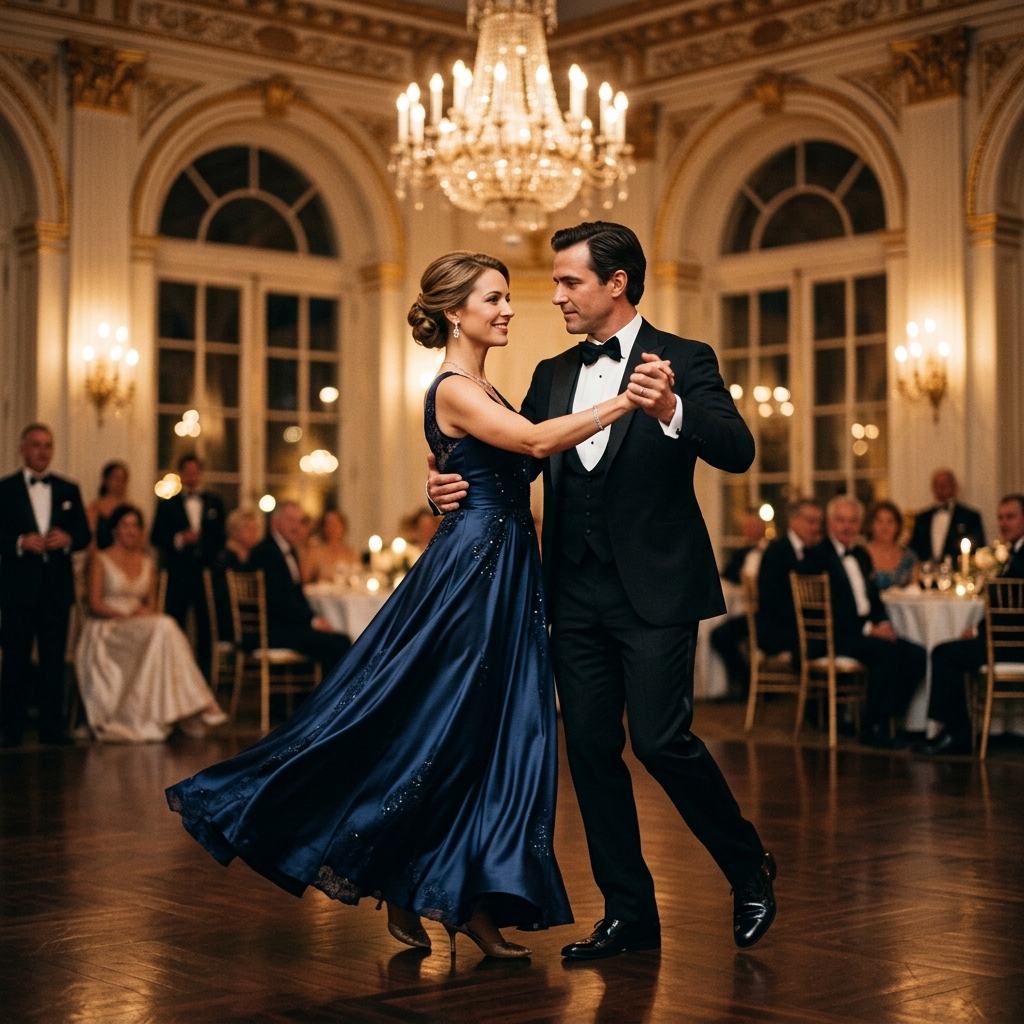
The Viennese Waltz is a classic and elegant ballroom dance that hails from Vienna, Austria. It is renowned for its graceful and sweeping movements, characterized by flowing turns and a sense of effortless gliding across the dance floor. The Viennese Waltz is celebrated for its beauty, grace, and timeless appeal, making it a beloved choice for formal events and ballroom competitions.
General Description
- The Viennese Waltz is a couple's dance, traditionally performed by a man and a woman.
- Dancers typically dress in formal attire, with the man wearing a tuxedo and the woman in an elegant ballroom gown.
- The dance is characterized by continuous, flowing movements and rapid turns.
- Dancers maintain a close embrace while executing the waltz's signature sweeping turns and rotations.
- Unlike the slower-paced American and International Waltzes, the Viennese Waltz is performed at a much faster tempo, with around 180-210 beats per minute.
- The dance is known for its grace, lightness, and the feeling of floating across the dance floor.
Music
The music for the Viennese Waltz is essential to its character and charm. It is typically set to classical waltz compositions, with famous composers such as Johann Strauss II, Franz Lehár, and others providing the enchanting melodies. The music features a three-four time signature and a lilting, waltz rhythm, which perfectly complements the dance's flowing movements. The orchestration often includes strings, woodwinds, and occasionally, the piano. Some well-known Viennese Waltz pieces include "The Blue Danube" and "Tales from the Vienna Woods" by Johann Strauss II.
History
The Viennese Waltz has its roots in the traditional waltz, which originated in the Alpine regions of Austria and Bavaria in the late 18th century. The waltz was initially considered scandalous due to its close-hold position and faster tempo compared to other dances of the time.
In the early 19th century, the Viennese Waltz emerged as a refined and formalized version of the waltz, becoming a staple of Viennese society's ballroom culture. It gained widespread popularity and became a symbol of elegance and grace during the Romantic era. The Viennese Waltz was notably popularized by Johann Strauss I and his son, Johann Strauss II, who composed numerous waltzes that are still beloved today.
Style
- The Viennese Waltz is characterized by its unique style and technique:
- Dancers move in a continuous rotational fashion, executing rapid turns and underarm spins.
- The dance emphasizes a feeling of "rise and fall" as couples glide across the floor.
- Precise footwork is essential, with small, graceful steps that maintain the dance's smooth flow.
- The dancers' posture is upright, and their frame is close, allowing for a strong connection between partners.
- Timing and synchronization are crucial in the Viennese Waltz, as the fast tempo requires precision in both steps and rotations.
Overall, the Viennese Waltz stands as a testament to the enduring allure of ballroom dance, capturing the essence of romance and sophistication in every graceful turn and sweep across the dance floor.